
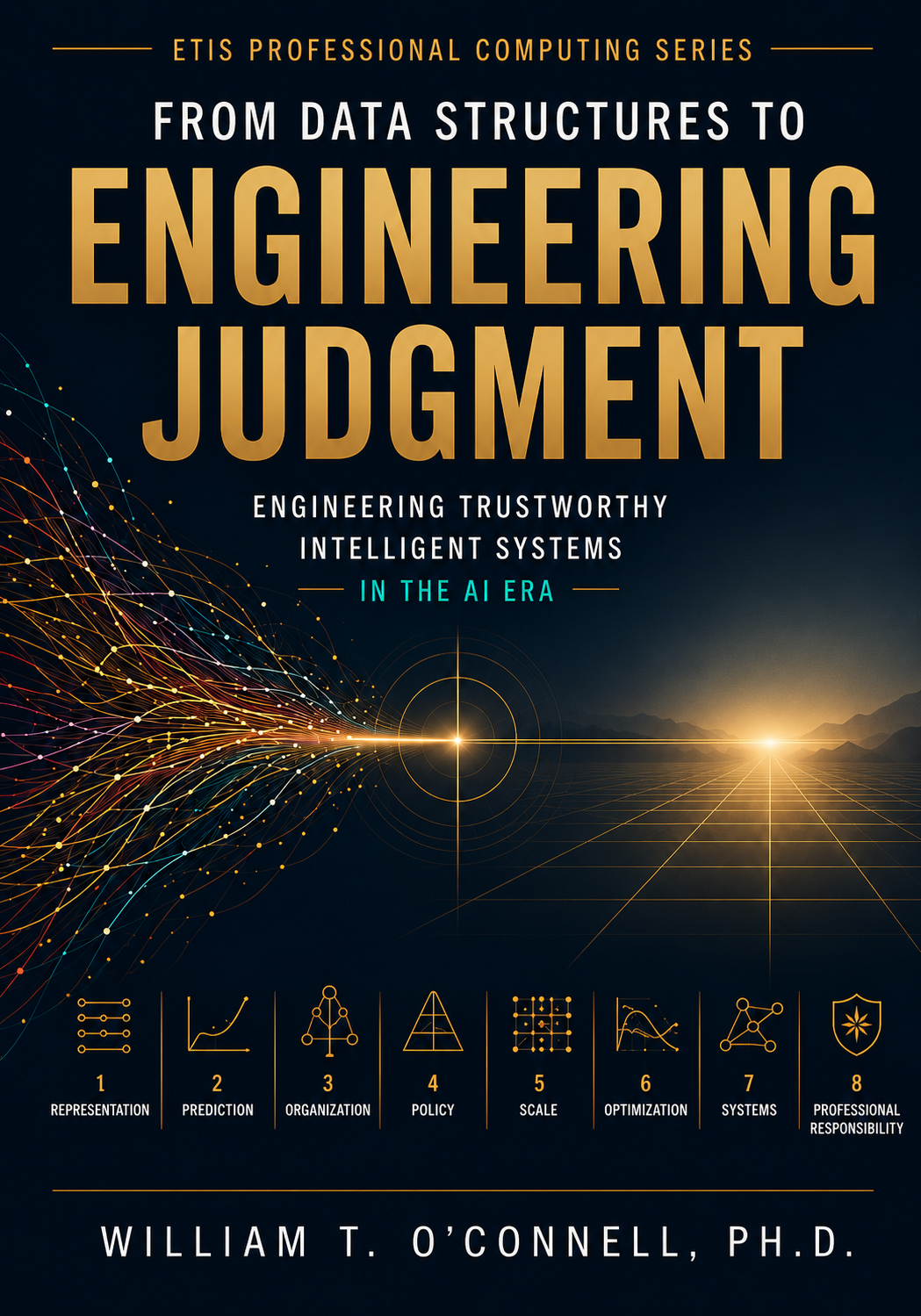
From Data Structures to Engineering Judgment
ETIS Professional Computing Series · Book 1
Engineering Trustworthy Intelligent Systems in the AI Era
William T. O'Connell, Ph.D.
Publication status
Published: August 2026 · First Edition
PDF edition: Available here as a free ETIS website download.
Amazon: Available now ↗
Paperback ISBN: 979-8-9966760-4-0
Hardcover ISBN: 979-8-9966760-5-7
About the Book
Implementation is becoming easier to obtain.
Trustworthy engineering remains difficult.
From Data Structures to Engineering Judgment uses the familiar technical foundation of data structures and algorithms to develop the capability that increasingly distinguishes engineers in the AI era: the ability to make explicit technical decisions, support them with evidence, understand their boundaries, evaluate tradeoffs, verify AI-assisted work, and remain accountable for consequences.
This is intentionally not a conventional data structures textbook, Java programming guide, or algorithms reference.
Its purpose is to transform readers from implementers into engineers who can reason, justify, verify, and own consequential technical work.
Reader Promise
By the end of the book, readers should be better prepared not only to implement a solution, but also to explain why it is appropriate, what evidence supports it, where its boundaries lie, and what conditions would require the decision to change.
The book repeatedly asks readers to move beyond implementation and examine:
- what a representation makes possible or difficult;
- what should be predicted before measurement begins;
- what a structure claims about the domain;
- which assumptions become fragile under scale;
- what policy is encoded in priority;
- why one valid choice is more appropriate than another in context;
- what behaviors emerge only when components become systems;
- and who owns the consequences when reality differs from the model.
The Professional Formation Arc
| Module | Technical vehicle | Formation capability | Professional question |
|---|---|---|---|
| 1 | Lists, stacks, queues | Representation | What can the system express naturally, and what becomes costly or unsafe? |
| 2 | Algorithm analysis | Prediction | How should work, memory, latency, and resource consumption change as the problem grows? |
| 3 | Trees | Organization | What hierarchy, ordering, or decomposition does the structure claim? |
| 4 | Hashing | Scale | Which assumptions about distribution, equality, capacity, and mutation support the expected behavior? |
| 5 | Priority queues | Priority | Who or what receives scarce attention first, and what fairness or starvation risks follow? |
| 6 | Sorting | Choice | Which valid alternative best satisfies the stated constraints, workload, and objectives? |
| 7 | Graphs | Systems | What becomes true only after components are connected into a larger system? |
| 8 | Production reality | Responsibility | What evidence supports readiness, what risks remain, and who owns the consequences? |
The arc is cumulative. Representation enables prediction. Prediction informs organization. Organization reveals the challenges of scale. Scale exposes policy decisions. Policy requires disciplined choice. Individual choices interact to produce system behavior. Together, these capabilities lead to responsible engineering decisions.
Who the Book Is For
The book is designed for:
- second-year computer science students;
- graduate students and advanced learners;
- educators who want to teach judgment, not only mechanics;
- practicing software engineers;
- readers preparing for an AI-shaped profession;
- and independent learners moving from programming toward professional engineering.
The common requirement is not a particular academic level. It is a willingness to move beyond implementation and ask what makes a technical decision justified, bounded, and trustworthy.
Relationship to ETIS
The ETIS website is the canonical online home for the book's publication record and companion ecosystem.
For this title, the website provides:
- book identity and bibliographic information;
- the authorized downloadable PDF edition;
- print-edition purchase links;
- companion resources;
- updates and errata;
- and educator and practitioner support materials.
Within the ETIS publishing architecture, the two-volume Engineering Trustworthy Intelligent Systems work is the foundational ETIS Framework Reference Work. From Data Structures to Engineering Judgment is Book 1 of the ETIS Professional Computing Series and applies and reinforces ETIS principles through a focused computing domain, using data structures and algorithms as the technical vehicle for developing professional engineering judgment.
The relationship is complementary rather than competitive or sequential. Neither work is a prerequisite for, or continuation of, the other: the Professional Computing Series develops and applies enduring engineering judgment in focused computing domains, while the Framework Reference Work provides the comprehensive lifecycle discipline for engineering, governing, operating, and stewarding trustworthy intelligent systems.
The Professional Computing Series develops engineering judgment in focused computing domains. The ETIS Framework Reference Work organizes trustworthy engineering across the full lifecycle.
Explore the ETIS Professional Computing Series → Explore the ETIS Framework Reference Work → Explore Downloads →