
Engineering Trustworthy Intelligent Systems
The ETIS Framework Reference Work
Software Engineering, Governance, and Operational Trust in the AI Era
William T. O'Connell, Ph.D.
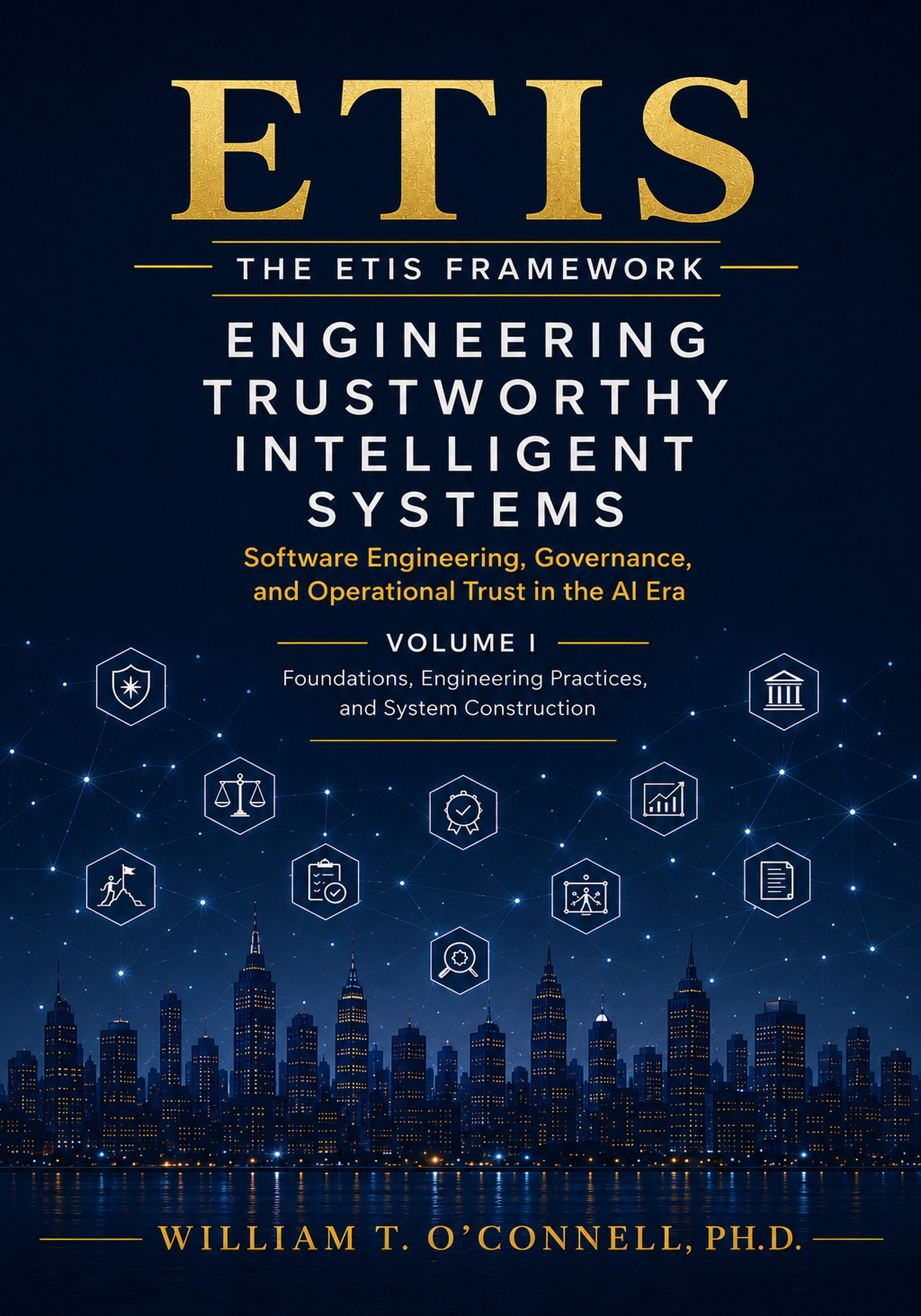
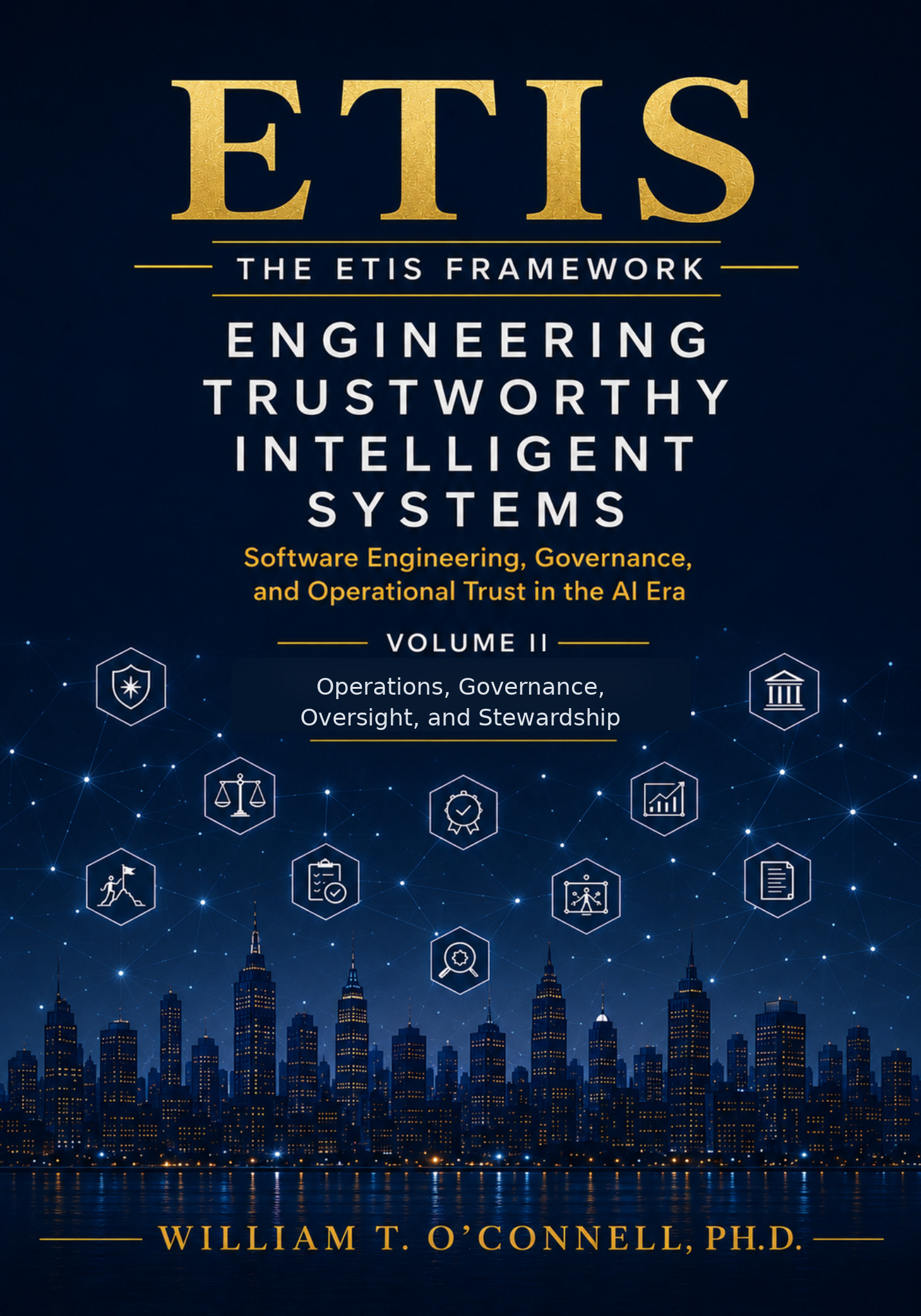
ETIS Two-Volume Professional Edition
One integrated framework. Two lifecycle movements.
Published: July 2026 · First Edition
Paperback ISBN: 979-8-9966760-0-2
Hardcover ISBN: 979-8-9966760-3-3
Published: July 2026 · First Edition
Paperback ISBN: 979-8-9966760-2-6
Hardcover ISBN: 979-8-9966760-1-9
One framework reference, two lifecycle movements
Engineering Trustworthy Intelligent Systems is one integrated professional work. Volume I carries the engineering journey from foundations and intent through requirements, architecture, planning, construction, AI-assisted implementation, independent verification, release readiness, and release defense. Volume II continues that journey into sustained operation, observability, security, reliability, AI governance, human oversight, incident learning, organizational trust, and long-term stewardship. The two-volume structure improves readability, teaching, reference, and professional use without dividing the intellectual framework.
The Foundational ETIS Reference Work
Engineering Trustworthy Intelligent Systems is the foundational reference work of the ETIS ecosystem—a comprehensive, 39-chapter professional framework for software engineering, governance, and operational trust in the AI era.
Across four parts and two integrated volumes, the work follows the engineering lifecycle from intent and requirements through architecture, construction, AI-assisted engineering, independent verification, and release defense—and then into sustained operations, observability, security, reliability, governance, human oversight, incident learning, organizational trust, and long-term stewardship.
The work is concerned with the engineering discipline required to create systems that can be understood, reviewed, verified, governed, operated, recovered, improved, and responsibly stewarded as AI becomes embedded throughout software engineering and organizational systems.
Its central concern is not whether an intelligent system can produce an impressive result under nominal conditions. It is whether the surrounding engineering system provides sufficient evidence, controls, observability, accountability, and recovery capability for people and organizations to trust what the system does over time.
Trust is engineered continuously through evidence, governance, and human stewardship.
Scope of the Reference Work
The two volumes together connect disciplines that are too often treated separately:
- software engineering foundations and professional judgment;
- requirements, constraints, and architecture;
- planning and engineering decision records;
- repository-centered engineering evidence;
- AI-assisted implementation with human accountability;
- code review and independent verification;
- testing, release readiness, and release defense;
- observability and operational readiness;
- security engineering and reliability;
- AI governance and human oversight;
- incident response, postmortems, and defect reduction;
- organizational trust and engineering leadership;
- continuous improvement, learning, and stewardship.
The result is a single lifecycle argument: trustworthy intelligent systems are not made trustworthy by a model, feature, checklist, or release event. Trustworthiness is accumulated through engineering decisions and evidence across the entire lifecycle.
One Work, Two Professional Volumes
The division between the volumes is deliberate:
Volume I asks how a system becomes defensibly ready for release. Volume II asks how that system remains worthy of trust after release.
| Volume | Scope | Central responsibility |
|---|---|---|
| Volume I — Foundations, Engineering Practices, and System Construction | Chapters 1–22 · Foundations through release defense | Frame, specify, architect, plan, construct, verify, review, and defend systems before sustained operation begins. |
| Volume II — Operations, Governance, Oversight, and Stewardship | Chapters 23–39 · Operations through long-term stewardship | Operate, observe, secure, govern, recover, learn from, improve, and steward systems after release. |
The volumes are complementary parts of one integrated framework. Readers can use them independently for targeted professional needs, but the complete ETIS argument crosses the release boundary and requires both.
The Professional Reference Architecture
The 39 chapters are organized across four major movements of the engineering lifecycle:
| Part | Chapters | Professional focus |
|---|---|---|
| Part I — Foundations | 1–7 | Engineering mindset, trust, evidence, repositories, governance foundations, and the changing nature of software engineering in the AI era. |
| Part II — Engineering Construction | 8–22 | Requirements, architecture, planning, design decisions, AI-assisted implementation, reviews, verification, release readiness, and release defense. |
| Part III — Operations and Governance | 23–32 | Postmortems, defect reduction, observability, operational readiness, security, AI governance, reliability, incident response, release governance, and organizational trust. |
| Part IV — Leadership and Future-State Engineering | 33–39 | Technical leadership, engineering stewardship, repository governance, continuous improvement, organizational learning, future-state engineering, and the evolution of trustworthy intelligent systems. |
The main chapters are supported by eight professional appendices that consolidate trustworthiness, review-board practices, repository-centered evidence, engineering principles, the LMU/COICP enterprise reference architecture, engineering judgment, AI governance, and ETIS terminology into reusable reference material.
How the Reference Work Fits the ETIS Ecosystem
The Reference Work is the intellectual center of a broader engineering ecosystem.
The book explains the complete lifecycle discipline. The rest of ETIS makes that discipline easier to enter, apply, teach, inspect, and reuse.
| If you want to… | Continue with… |
|---|---|
| Understand the engineering problem ETIS addresses | Why ETIS? |
| Get a concise introduction to the framework | What is ETIS? |
| Understand the complete framework structure | ETIS Framework Overview |
| Read the complete work online | Read ETIS Online |
| Understand how repositories preserve engineering evidence | Repository-Centered Engineering |
| Use ETIS in practical engineering work | Engineering Platform |
| Teach, learn, or adopt ETIS educationally | Educational Ecosystem |
| Read focused, citable treatments of ETIS ideas | ETIS Publications |
| Use reusable professional reference material | ETIS Appendices |
| Find PDFs, book editions, and offline products | Downloads |
| Understand available formats and editions | ETIS Library |
This structure is intentional:
Framework Reference Work
Complete lifecycle doctrine
        ↓
Focused Publications + Appendices
Explanation, reference, and decision support
        ↓
Educational Ecosystem
Professional formation and adoption
        ↓
Engineering Platform + Repositories
Practical application and preserved evidence
        ↓
Operations, Learning, and Stewardship
Trust maintained over time
Relationship to the ETIS Professional Computing Series
The ETIS Professional Computing Series serves a different but complementary purpose.
Its inaugural title, From Data Structures to Engineering Judgment, uses data structures and algorithms as the teaching vehicle for developing explicit, evidence-based technical judgment: identifying assumptions, protecting invariants, testing claims, defining evidence boundaries, evaluating tradeoffs, understanding system consequences, verifying AI-assisted work, and owning decisions professionally.
The Framework Reference Work applies related disciplines across complete software lifecycles and intelligent systems that must be engineered, governed, operated, and stewarded over time.
The relationship is complementary rather than sequential: neither work is a prerequisite for, or continuation of, the other.
The Professional Computing Series develops engineering judgment in focused computing domains. The ETIS Framework Reference Work organizes trustworthy engineering across the full lifecycle.
Explore the ETIS Professional Computing Series → Explore From Data Structures to Engineering Judgment →
Editions and Access
The ETIS Framework Reference Work is available through complementary forms designed for different kinds of professional use.
| Format | Best for |
|---|---|
| Complete online edition | Navigation, current public reference, cross-linking, and ongoing stewardship |
| Complete downloadable PDF | Offline reading, archiving, teaching preparation, and complete-reference use |
| Two-volume PDF edition | Focused reading and professional reference by lifecycle domain |
| Paperback editions | Classroom, professional reading, annotation, and institutional use |
| Hardcover editions | Long-term professional, organizational, and library reference |
The online edition remains the authoritative and continuously stewarded public source.