
ETIS Professional Computing Series
Professional judgment for computing in the AI era
The ETIS Professional Computing Series develops the professional judgment required to understand, verify, build, operate, and steward trustworthy systems in the AI era.
The series is grounded in a simple reality:
As implementation becomes easier to obtain, engineering understanding, evidence, judgment, and accountability become more valuable — not less.
Series Purpose
Series titles are intended to:
- develop transferable engineering judgment rather than tool-specific proficiency;
- connect technical mechanisms to system outcomes and professional consequences;
- make assumptions, invariants, evidence, and tradeoffs explicit;
- integrate AI-assisted engineering without outsourcing human understanding or accountability;
- connect classroom foundations to professional engineering practice;
- remain useful as programming languages, frameworks, platforms, and AI tools change;
- and stand on their own while maintaining a clear intellectual relationship to the broader ETIS ecosystem.
The series is intentionally selective. It is not organized around a publication cadence or a need to fill a catalog. New titles should add a durable professional capability or meaningful domain-specific contribution.
Current Series Catalog
Book 1 — From Data Structures to Engineering Judgment
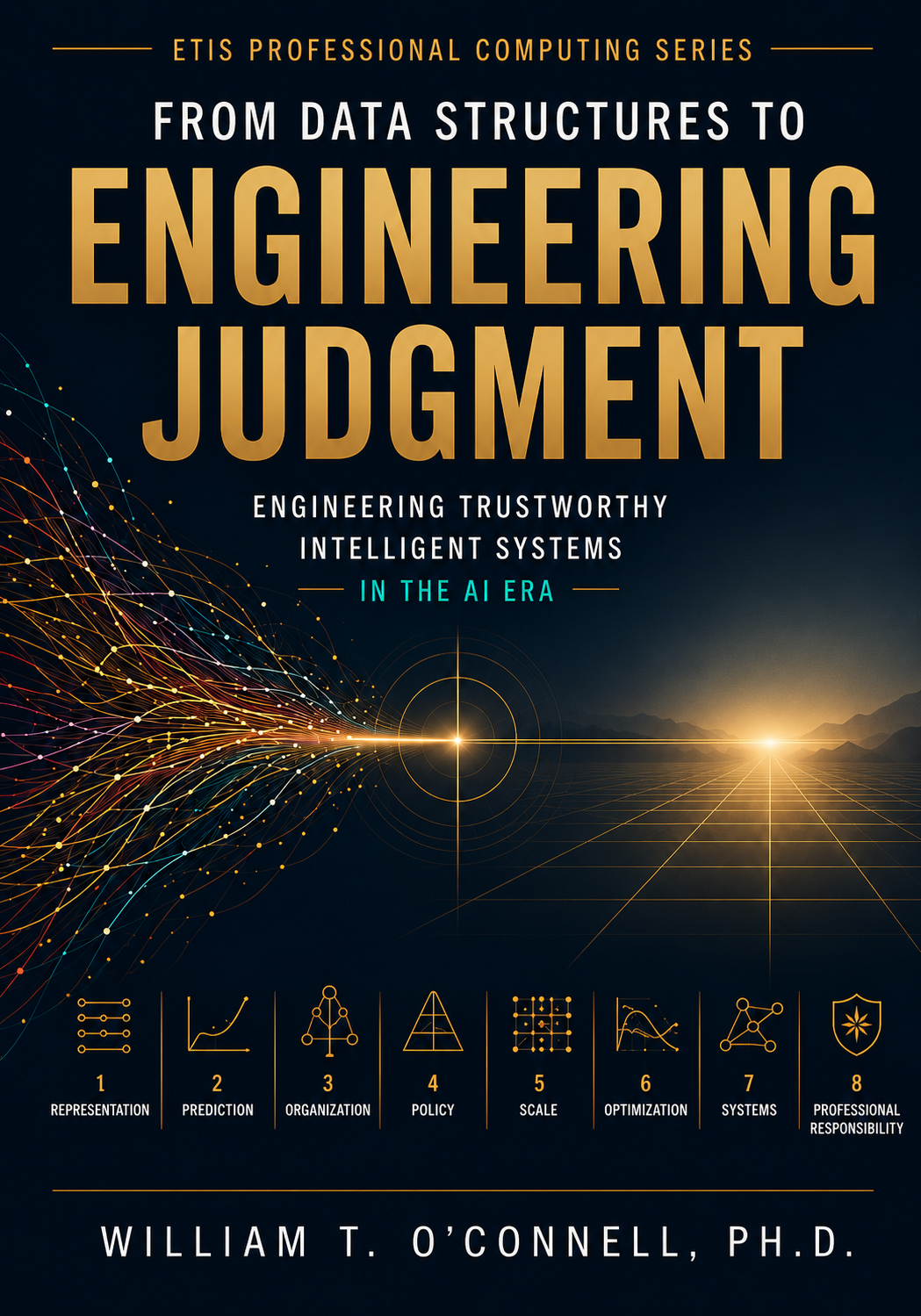
Engineering Trustworthy Intelligent Systems in the AI Era
William T. O'Connell, Ph.D.
Published: August 2026 · First Edition
PDF edition: Free download on the ETIS website
Amazon: Available now ↗
Paperback ISBN: 979-8-9966760-4-0
Hardcover ISBN: 979-8-9966760-5-7
The inaugural title uses data structures and algorithms as a vehicle for developing engineering judgment rather than treating technical topics as isolated mechanisms to memorize.
The book develops eight cumulative professional capabilities:
| Technical vehicle | Formation capability | Professional focus |
|---|---|---|
| Lists, stacks, and queues | Representation | What can the system express naturally, and what becomes costly or unsafe? |
| Algorithm analysis | Prediction | How should work, memory, latency, and resource consumption change as the problem grows? |
| Trees | Organization | What hierarchy, ordering, or decomposition does the structure claim? |
| Hashing | Scale | Which assumptions about distribution, equality, capacity, and mutation support expected behavior? |
| Priority queues | Priority | Who or what receives scarce attention first, and what fairness or starvation risks follow? |
| Sorting | Choice | Which valid alternative best satisfies the stated constraints, workload, and objectives? |
| Graphs | Systems | What becomes true only after components are connected into a larger system? |
| Production reality | Responsibility | What evidence supports readiness, what risks remain, and who owns the consequences? |
Explore the Book → View on Amazon ↗ Companion Resources → Updates & Errata →
Series Relationship to the ETIS Framework
The series and the ETIS Framework are related but not identical.
- The ETIS Framework Reference Work defines the complete lifecycle discipline.
- The Professional Computing Series develops the professional judgment needed to apply that discipline responsibly.
The relationship is complementary rather than competitive or sequential:
                    ETIS Ecosystem
                          │
          ┌───────────────┴───────────────┐
          │                               │
Professional Computing            Framework Reference Work
          │                               │
Engineering Judgment              Full-Lifecycle Engineering
Technical Decision-Making         Governance and Oversight
Evidence and Tradeoffs            Operational Trust
Professional Responsibility       Long-Term Stewardship
          │                               │
          └───────────────┬───────────────┘
                          │
             Trustworthy Engineering
                 in the AI Era
That is why the series belongs within the ETIS publishing ecosystem while each title remains capable of standing on its own. The Professional Computing Series applies and reinforces ETIS principles in focused computing domains without serving as a prerequisite to, or continuation of, the Framework Reference Work.